mercoledì 19 aprile 2017

JDM: Jolie Database Manager for PostgreSQL database

Here we host a post from Danilo Sorano who collaborated with us and the Jolie team during his training period at Imola Informatica and italianaSoftware. The training period of Danilo is part of his studies at the University of Bologna. Danilo chose to work on a project about Jolie and databases. In particular, he contributed to develop a tool for automatically extracting a jolie service which facilitates the interactions with an existing database in PostgreSQL.

Congratulations to Danilo! His post follows:

JDM
Jolie Database Manager for PostgreSQL database by Danilo Sorano

The jolie database manager is a tool whose goal is to create a facilitator for the management of PostgresSQl data sources by using microservices. The tool can be get on github: https://github.com/jolie/db_connector
The main purpose of JDM is to simplify database management operations, specifically the simplifications of the insertion, modification, deletion and retrieval of data. The tool has been designed for preventing the user to write standard queries on tables and views which can be easily automatized.
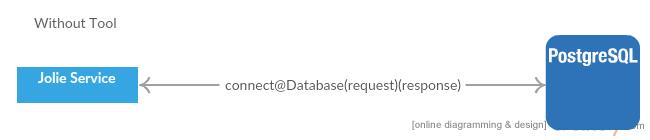



Usage instructions:
  1. Creating the database and tables / views. Only if you are creating a database from scratch. Otherwise skip this step. 
  2. Start the JDM server running main_table_generator.ol inside folder server
  3. Configure the information necessary to connect with the database (file config.ini)
  4. Start the client running createDbService.ol inside folder client
  5. In folder db_services all the files will be generated: Metadata extraction from the database and creation of the service for the database.
The database service is divided in two parts:
  • Automatic service
  • Custom service
The automatic part provides basic operations for the database:
  • Create: INSERT query
  • Update: UPDATE query
  • Remove: DELETE query
  • Get: SELECT query
The management of more complex operations such as JOIN between tables must be managed by creating view by the user.

The custom part allows for  the development of customized query on the database and it can be freely edited by the user. This function gives to the user the possibility of being able to create the most complex operations, for example, to manage nested query.

From an architectural point of view, the database service's main part  embeds the custom part and automatic one. This mechanism allows the two parties to be independent of each other, thus allowing the modification of the automatic part every time that, for example, is added to a view without going to change the custom part.
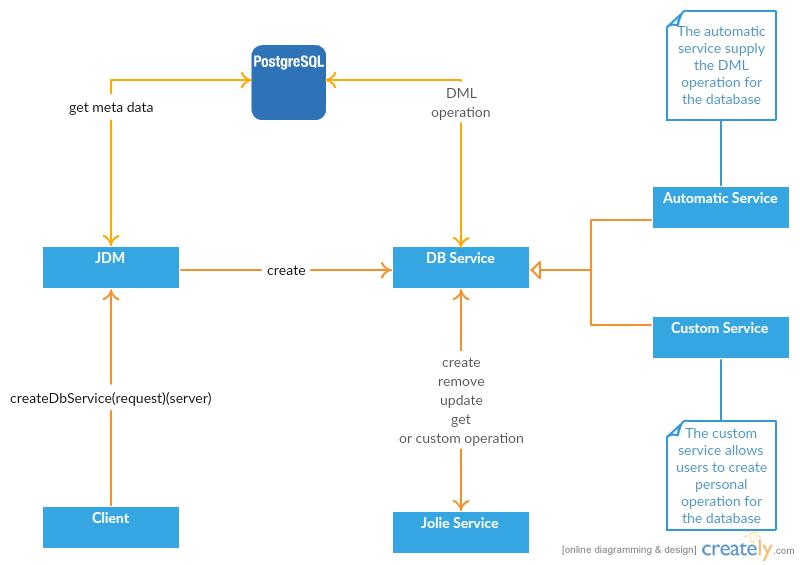
Example: Creation of a database service In order to explain how the tool works we will use the example contained in the folder "examples", where there is a file sql "e-commerce.sql" to be used to generate the test database. The file creates a database of a simple e-commerce with three tables. The three tables are:
  • user (fiscal code, name, surname, email)
  • product (bar code, product name, description, quantity)
  • order (Order id, product id, user id, quantity)
The service can be used by changing the information in the file "config.ini” [db_connection] HOST=localhost DRIVER=postgresql PORT=5432 DATABASE=e-commerce USERNAME=postgres PASSWORD=postgres
Creating a service for a database
  1. Creation of PostgreSql database and its tables and views (It's possible using the e-commerce example.
  2. Starting the Tool for generate the service (main_table_generator.ol)
  3. Change the information in the config.ini file.
WINDOWS
  • Start the script server TableGenerator.bat
  • Start the script client CreateDbService.bat
  • If everything went well the service is created
OTHER OS
  • Go in the folder "server" and run the jolie file "main_table_generator.ol
  • Go in the folder "client" and run the jolie file "createDbService.ol
  • If the creation of the service is successful, the server print the message: “Database table generation is finished with SUCCESS”.
Using the service of the example The generated service for the example of the e-commerce is divided into two parts:
  • automatic
  • custom
The automatic part is represented by the file main_automatic_ecommerce.ol which contains the operations:
  • createuser, createproduct and createorder
  • getUser, getproduct and getOrder
  • updateUser, updateproduct and updateorder
  • removeuser, removeproduct and removeorder.
On the other hand, the custom part as mentioned above, allows the user to create his own customized operations. Example of a client File try_operations.ol in the example, shows the usage of the basic operations of the automatic part. The file is structred as it follows:
  1. Importing of the interface and the location
    include"../db_services/e_commerce_handler_service/automatic_service/public/interfaces/includes.iol"
    include "../db_services/e_commerce_handler_service/locations.iol"
  2. Creation of an output port for the service
    outputPort Test {
    Location: e_commerce
    Protocol: sodep
    Interfaces: userInterface, orderInterface, productInterface
    }
    Note that the default location is "socket://localhost:9100" taht is contained inside the file locations.iol
  3. Inside the main you can make the call to the service operations. 
The Filter Before introducing the individual operations it is better to explain the filter field. The filter field is a FilterType type which is defined inside "automatic_service/public/types/e_commerceDatabaseCommonTypes.iol" type ExpressionFilterType: void { .eq?: bool .gt?: bool .lt?: bool .gteq?: bool .lteq?: bool .noteq?: bool } type FilterType: void { .column_name: string .column_value: any .expression: ExpressionFilterType .and_operator?: bool .or_operator?: bool } The filter field is important to define the where clause of the query:.
  • column_value: value of the colum
  • column_name: name of the column of the expression
  • expression: the operator used to check the value, this is an ExpressionFilterType
  • and_operator: we define this field only if we want to concatenate another expression, in this case an AND operator
  • or_operator: we define this field only if we want to concatenate another expression, in this case an OR operator
The ExpressionFilterType define the operator:
  • lteq: "<="
  • eq: "="
  • gt: ">"
  • lt: "<"
  • gteq: ">="
  • noteq: "!="
As an example, let us suppose to define the following where clause "WHERE 'product_name' = 'Fried Chicken' AND quantita >= 10": getproductRequest.filter.column_name = "product_name"; getproductRequest.filter.column_value = "Fried Chicken"; getproductRequest.filter.expression.eq = true; getproductRequest.filter.and_operator = true; getproductRequest.filter[1].column_name = "quantity"; getproductRequest.filter[1].column_value = 10; getproductRequest.filter[1].expression.gteq = true; Example of a Get operation To select one or more row in the product table of the e-commerce example we use the operation getproduct getproduct( getproductRequest )( getproductResponse ) throws SQLException SQLServerException It is worth noting that the fields inside the request type is only the filter fields. type getproductRequest:void { .filter*:FilterType } In the response message we will get the rows of the select query type getproductRowType:void { .id_product:int .product_name:string .description:string .quantity:long } type getproductResponse:void { .row*:getproductRowType } This operation select one or more row inside the product table. Here an example of the call: /*Get of the all rows of “Fried Chicken” with the quantity equal or greater then ten*/ getproductRequest.filter.column_name = "product_name"; getproductRequest.filter.column_value = "Fried Chicken"; getproductRequest.filter.expression.eq = true; getproductRequest.filter.and_operator = true; getproductRequest.filter[1].column_name = "quantity"; getproductRequest.filter[1].column_value = 10; getproductRequest.filter[1].expression.gteq = true; getproduct@Test(getproductRequest)( response ); Example of a Create operation To insert a row in the user table we use createuser operation createuser( createuserRequest )( createuserResponse ) throws SQLException SQLServerException - createuserRequest The fields inside the request type are the fields of the user table. type createuserRequest:void { .fiscalcode:string .name:string .surname:string .email:string } - response: createuserResponse it's a void type This operation insert a row inside the user table, to understand better how it’s work we show an example: /*The user John Silver is inserted inside the user table*/ createuserRequest.fiscalcode = "1"; createuserRequest.name = "John"; createuserRequest.surname = "Silver"; createuserRequest.email = "john.silver@mail.com"; createuser@Test(createuserRequest)(); Example of a Remove operation To insert a row in the user table we use removeuser operation removeuser( removeuserRequest )( removeuserResponse ) throws SQLException SQLServerException - removeuserRequest There is only one filter fields, where specify the condition of WHERE clause type removeuserRequest:void { .filter*:FilterType } - response: removeuseResponse it's a void type This operation remove one or more row inside the user table, to understand better how it’s work we show an example: /*In this case we remove the user John Silver*/ removeuserRequest.filter.column_name = "surname"; removeuserRequest.filter.column_value = "Silver"; removeuserRequest.filter.expression.eq = true; removeuser@Test(removeuserRequest)(); Example of an Update operation To update one or more rows in the user table we use updateuser operation updateuser( updateuserRequest )( updateuserResponse ) throws SQLException SQLServerException - updateuserRequest The fields inside the request type are the fields of the user table and filter field type updateuserRequest:void { .fiscalcode?:string .name?:string .surname?:string .email?:string .filter*:FilterType } - response: updateuserResponse it's a void type This operation update one or more row inside the user table, to understand better how it’s work we show an example: /*Changing the surname of John from “Silver” to “Smith”*/ updateuserRequest.surname = "Smith"; updateuserRequest.filter.column_name = "surname"; updateuserRequest.filter.column_value = "Silver"; updateuserRequest.filter.expression.eq = true; updateuser@Test(updateuserRequest)(); Future features
  • Ability to integrate the service, for more Database (Postgres, MySql ecc...).
  • Possibility to extend the management of most types and especially more complex.
Contact
  1. C


mercoledì 28 dicembre 2016

L'esperienza del Meeting On Microservices 2016! (in italian)

Il 20 Dicembre si è svolto a Bologna il Meeting on Microservices (MoM) organizzato da italianaSoftware al fine di creare un primo momento di incontro tra aziende, pubbliche amministrazioni e mondo della ricerca sul tema dei microservizi. Siamo molto contenti che l'evento abbia avuto successo ed abbia visto la partecipazione di un buon numero di interessati ed una serie di interventi davvero stimolanti. Come prima conclusione a seguito di questa giornata, si può sicuramente affermare che il tema "microservizi" è ad oggi un tema di assoluto interesse e che tutti gli addetti ai lavori sono intenzionati a conoscere e a comprendere maggiormente le opportunità ed i rischi che questo nuovo approccio architetturale può offrire.


L'elemento positivo della prima edizione del MoM è certamente quello di essere riuscito a mettere insieme punti di vista sia teorici ed accademici che casi pratici d'uso di quelle aziende che per prime hanno implementato soluzioni orientate ai microservizi. La cosa probabilmente più rilevante che qui ci preme mettere in risalto è come questa soluzione architetturale possa essere adottata da aziende di tutte le dimensioni per risolvere i problemi più disparati. Le presentazioni di Monrif ed H2B hanno illustrato come si possano gestire con i microservizi sia i flussi di archiviazione documentale che l'implementazione di una vera e propria piattaforma B2B. Sicuramente va sottolineato come la loro adozione necessita di ripensare alcuni dei processi esistenti per la progettazione e la programmazione del software e che tante sfide si aprono ora nel mondo IT a seguito dell'adozione dei microservizi. Da una parte l'analisi ed il design dell'architettura diventano passi fondamentali per tutti i team IT che intendono adottare i microservizi e dall'altra molte attività che vengono generalmente esternalizzate possono ora essere riportate all'interno producendo da una parte risparmio e dall'altra una risposta più celere alle esigenze del business.

Il dibattito sui microservizi è appena entrato nel vivo e nei prossimi anni siamo certi che si riparlerà a più riprese di essi. Noi, come italianaSoftware ci saremo e lavoreremo affinchè il MoM possa diventare un evento periodico di carattere nazionale che possa diventare un riferimento per tutti coloro che sono interessati all'argomento.


Di seguito riportiamo l'elenco delle presentazioni con un brevissimo riassunto sui loro contenuti.

Genesi di una tecnologia, dalla ricerca all'industria... - Maurizio Gabbrielli (DISI - Università di Bologna)
Innovare è una sfida sempre difficile dove la possibilità di sbagliare deve essere considerata sin dall'inizio. Lo sviluppo e la maturazione della tecnologia Jolie sono un caso di studio interessante dove dallo sviluppo di un modello matematico si è riusciti a passare ad un linguaggio di programmazione che porta benefici al mondo produttivo.


La rivoluzione dei microservizi - Claudio Guidi (italianaSoftware)
I microservizi promettono di rivoluzionare il modo di progettare e programmare software. italianaSoftware propone una tecnologia specifica per affrontare la programmazione dei microservizi: jolie. Essa si distingue perché propone di approcciare i microservizi tramite un paradogma linguistico piuttosto che tramite un paradigma sistemistico che è quello più conosciuto fino a questo momento.


Implementazione di una soluzione a microservizi: benefici organizzativi ed economici - Balint Maschio (Monrif s.p.a.)
Monrif s.p.a. ha iniziato ad utilizzare soluzioni a microservizi inizialmente per risolvere i problemi di system integration legati all'archiviazione documentale da ambiente SAP verso applicativi di terze parti. Ora ha iniziato a creare veri e propri flussi tramite micro-orchestratori dedicati.


Industria 4.0, come verrà rivoluzionata l'industria italiana - Paola Perini (Innovami)
Industria 4.0 è la nuova parola chiave con la quale si vuole descrivere il processo già in atto di rivoluzione del settore industriale italiano dove "ogni azienda si dovrà trasformare anche in un'azienda software".


H2B e i microservices: un caso di successo - Alessandro Suzzi (H2B)
I microservizi hanno aiutato H2B nel realizzare sia il loro applicativo ad agenti che i portali web B2B per la gestione del catalogo prodotti e degli ordini per un insieme di aziende nel settore delle ferramente gestite da H2B.

Dalle Service Oriented Architectures (SOA) ai microservizi - Claudio Bergamini (Imola Informatica)
Service Oriented Architectures e microservizi vengono spesso accoumnati e confrontati tra di loro. Il tema è sicuramente interessante, entrambe posano le proprie radici sull'idea di servizio come componente seppure con differenze implementative. Di certo c'è che sarà l'analisi specifica dei diversi scenari di utilizzo a stabilire dove sia meglio adottare l'una o l'altra soluzione.

Devops, Cloud e Container - Luca Acquaviva (Imola Informatica)
L'introduzione dei microservizi e la gestione dei loro container in particolare, porta a dover ripensare la propria infrastruttura ed i propri processi Devops. La stessa architettura di un applicativo web può arrivare a cambiare radicalmente.

Microservizi, scenari del prossimo e del lontano futuro - Saverio Giallorenzo (DISI - UNiversità di Bologna)
I microservizi sono con ogni probabilità il trampolino di lancio verso scenari futuri estremamente interessanti da esplorare. Tra le diverse ramificazioni a cui essi possono portare c'è sicuramente quello delle coreografie attualmente esplorato all'interno dell'Università di Bologna.